The National Association of Black Geoscientists
NABG Celebrates Black History Month, 2026
February 27, 2026
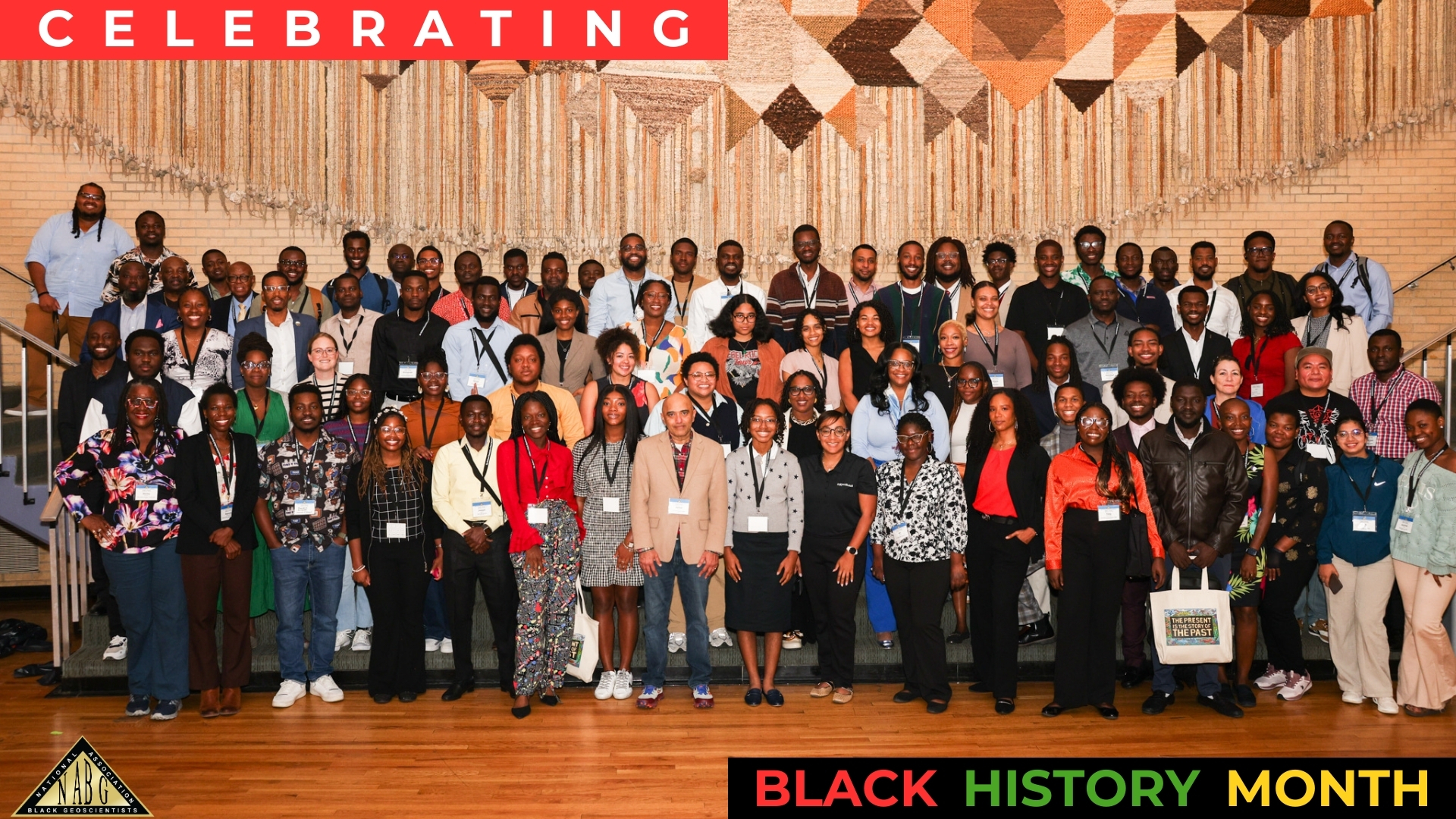
As Black History Month comes to a close, we reflect on the scientists, educators, leaders, and explorers we’ve highlighted throughout February. They are extraordinary — but they are not exceptions. They are part of a powerful and growing community of Black geoscientists shaping research, policy, education, industry, and exploration across the globe.
The National Association of Black Geoscientists (NABG) exists to support, connect, and elevate this community. From students presenting their first posters to senior scientists leading institutions, NABG creates space for mentorship, collaboration, leadership development, and lasting impact in the geosciences.
The individuals we celebrated this month represent just a fraction of the brilliance within our network. There are many more stories, many more contributions, and many more futures being built right now. Black history in the geosciences is not confined to a month — it is ongoing, evolving, and deeply embedded in the work that moves our field forward.
If you believe in expanding access, strengthening representation, and building pathways for the next generation of geoscientists, we invite you to stand with us.
Join. Support. Partner. Invest in the future of geoscience.
Below is a recap of our 2026 Black History Month Geoscientist Features!
This Black History Month, we proudly honor Dr. A. Wesley “Wes” Ward—a pioneering geoscientist, mentor, and leader whose impact spans planetary science, public service, and generations of geoscientists.
From his early academic journey in geology and planetary science to a distinguished career at the U.S. Geological Survey, Dr. Ward helped shape our understanding of terrestrial and Martian eolian processes while serving in pivotal leadership roles, including Chief Scientist of the USGS Astrogeology Program and Regional Executive for the Southwest Region.
Beyond his scientific achievements, Wes’s legacy is deeply rooted in service and mentorship. As a past president and longtime leader of the National Association of Black Geoscientists, he has been a tireless advocate for equity, access, and representation in the geosciences—uplifting students, early-career scientists, and professionals across institutions.
His work with the Geological Society of America, leadership in minority participation programs, and commitment to amplifying underrepresented voices reflect a career defined not just by excellence, but by lasting impact.
This Black History Month, the National Association of Black Geoscientists highlights Zelma Maine Jackson, a geologist who entered the field at a time when few women—and even fewer women of color—were working in oil and gas.
When Jackson began her career in the 1970s, one of her first assignments was as a well-site geologist on a petroleum drilling rig near Albuquerque, New Mexico. There, she evaluated core samples in real time to determine drilling viability while working under demanding conditions.
Born in South Carolina and a member of the Gullah Geechee community, Jackson was raised in part in Germany, where she attended German schools on an advanced academic track, building a strong foundation in math and science at an early age. She later earned her geology degree from Virginia State University, studying under Dr. Mack Gipson Jr., the first African American man to earn a doctorate in geology.
Her career spanned exploration geology and decades of environmental work at the Hanford Site in Washington State, critical to contamination monitoring and cleanup.
NABG recognizes contributions like Zelma Maine Jackson’s, work that strengthened the science and helped broaden opportunity in the geosciences.
This Black History Month, the National Association of Black Geoscientists (NABG) celebrates Dr. Hendratta Ali — geochemist, educator, mentor, and leader.
With academic roots spanning from the University of Yaoundé in Cameroon and a Ph.D. from Oklahoma State University, Dr. Ali’s career bridges international scholarship and applied geoscience. Her expertise spans aqueous, environmental, and stable isotope geochemistry, petroleum geology, sediment geochemistry, groundwater exploration, and geophysical well logging.
Dr. Ali’s research explores human impacts on water chemistry and carbon cycling, dissolved inorganic carbon evolution in mine environments, hydrocarbon degradation in shallow reservoirs, and sediment geochemistry across carbonate and petroleum systems. Her work has been published in leading journals and featured in the Springer Handbook of Petroleum Technology, reflecting both scientific rigor and industry relevance.
Beyond research, Dr. Ali’s impact is deeply rooted in education and mentorship. She teaches across the geoscience curriculum and under her guidance, students have earned research awards and national recognition through SEG and AAPG programs.
Her leadership extends across professional societies and contributions to advancing equity and professional development within the geosciences. Her recognitions include the Oklahoma State University Rising Star Award, the AAPG Inspirational Educator Award, and multiple mentoring and research honors.
In 2023, Dr. Ali received the NABG Catalyst Award for achievement and excellence in advocating for underrepresented and marginalized groups.
NABG honors Dr. Hendratta Ali for her commitment to scientific excellence, student development, and advancing geoscience across disciplines and communities.
This Black History Month, the National Association of Black Geoscientists celebrates Dr. Sian “Leo” Proctor, Ph.D. — a visionary artist, futurist, explorer, and geoscientist whose work expands how we imagine science, space, and humanity.
Dr. Proctor made history as the mission pilot for SpaceX Inspiration4, becoming the first African-American woman to pilot a spacecraft and the first Black commercial astronaut. She was also the first African-American to paint in space, bringing artistic expression into orbit and offering a new way to see Earth from above.
Born in Guam to a father who worked at NASA’s tracking station during the Apollo missions, Dr. Proctor’s lifelong connection to space and Earth sciences shaped her path. With advanced degrees in Environmental Science, Geology, and Science Education, and experience as a geoscience professor, her work uniquely bridges scientific understanding and creative expression.
Through her company Space2inspire, Dr. Proctor creates Afrofuturist art that advocates for a just, equitable, diverse, and inclusive future in space and STEM. As an educator, international speaker, and advisor on the National Space Council Users’ Advisory Group, she continues to shape conversations around climate, workforce development, and humanity’s future among the stars.
NABG honors Dr. Sian Proctor for expanding the boundaries of geoscience, space exploration, and creative vision—and for reminding us that science and art together can change how we see our world.
The National Association of Black Geoscientists is proud to highlight Dr. Lucien Nana Yobo PhD, an Assistant Professor in the Department of Geology and Geophysics at Texas A&M University, whose research advances our understanding of Earth’s deep-time environmental change.
Dr. Nana Yabo is an isotope geochemist and stratigrapher who studies how Earth’s surface environments have responded to major Earth-system perturbations through time. His work extracts geochemical signals preserved in marine sedimentary rocks, to reconstruct past biogeochemical conditions associated with large igneous provinces, volcanic activity, extraterrestrial inputs, and climate change.
By integrating these proxy records with numerical box models, Dr. Nana Yabo links sedimentary archives to volcanic, tectonic, and climate drivers at the Earth-system scale. His research spans much of geologic time and includes studies of ocean anoxic events, mass extinction intervals, rapid climate transitions, and modern sedimentary systems.
Dr. Nana Yabo is currently seeking motivated graduate students and postdoctoral researchers to join his research group. Undergraduate students at Texas A&M with interests in geology or chemistry are also encouraged to reach out to explore potential research opportunities.
NABG celebrates scientists who push the frontiers of geoscience while creating pathways for the next generation of researchers.
This Black History Month, the National Association of Black Geoscientists celebrates Dr. Brandon Jones, current President of the American Geophysical Union and a dedicated leader in the geoscience community.
Elected to the AGU Board of Directors in 2017, Jones has served in multiple leadership roles, including AGU’s Talent Pool Task Force, Leadership Development and Governance Committee, and Strategic Plan Writing Team. His work reflects a long-standing commitment to strengthening scientific leadership and governance at the highest levels.
As a former federal scientist, Jones spent more than two decades expanding access to STEM education and supporting students and early-career researchers. He has developed programs that increase funding access, mentorship opportunities, and career pathways in the geosciences—ensuring that aspiring scientists have the tools and support needed to thrive.
Jones’s passion for science began in Ohio, inspired by programs like Jacques Cousteau and Wild Kingdom, which sparked a lifelong curiosity about the natural world. He earned his bachelor’s degree in biology from Lincoln University, an HBCU in Pennsylvania, and later completed both his master’s and doctoral degrees in Marine Sciences at the University of Delaware’s College of Earth, Ocean and Environment.
A member of NABG, ASLO, and GSA, Brandon Jones exemplifies leadership, service, and commitment to the future of geoscience.
This Black History Month, NABG recognizes leaders like Dr. Brandon Jones who are shaping institutions, expanding opportunity, and strengthening the scientific community for generations to come.
This Black History Month, the National Association of Black Geoscientists celebrates Dr. Frederic “Ric” Wilson, whose nearly 50-year career with the U.S. Geological Survey in Alaska reflects a lifetime devoted to science, discovery, and building what did not previously exist.
After earning his bachelor’s degree in 1971, Wilson pursued his master’s at the University of Alaska in 1973—likely becoming the first Black graduate student in the department’s history. Though he initially planned to stay only briefly, Alaska became home. Following his Ph.D. at Dartmouth College, he returned in 1980 to build a Potassium-Argon dating laboratory for the USGS in Anchorage—literally constructing the Argon Extraction Lab himself alongside an assistant.
From helicopter hours across the state to leading mapping projects within the Alaska Mineral Resource Assessment Program, Dr. Wilson helped lay the scientific foundation for understanding Alaska’s geology. His work culminated in the 2015 Geologic Map of Alaska, the first fully digital geologic map of the state—a database that will support generations of scientists in understanding mineral, energy, and tectonic systems.
Throughout his career, Dr. Wilson has spoken openly about being the “lonely only”—often the only Black geologist in the room—while remaining committed to developing the next generation.
“Geology and earth sciences can help kids know and understand their place in the natural world and in their community,” he says. “That’s especially important for Black kids who don’t usually get that opportunity to explore.”
This Black History Month, NABG honors Dr. Ric Wilson for a career defined by curiosity, rigor, and a belief that belonging in science should never be rare.
This Black History Month, the National Association of Black Geoscientists (NABG) celebrates Maiya May — a storyteller, science communicator, and host who is reshaping how we connect with nature, climate, and environmental science.
Growing up near Davidson-Arabia Mountain Nature Preserve in Lithonia, Georgia, Maiya developed an early love for the outdoors. Exploring trails, abandoned farm structures, and the landscapes that would later surround her high school laid the foundation for a career rooted in weather, climate, and environmental literacy.
After studying geography and atmospheric science at the University of Missouri-Columbia and gaining experience with outlets including The Weather Channel, Maiya chose an unconventional path — blending science with storytelling. Recognizing the lack of diversity she observed in natural spaces, she committed herself to creating content that inspires deeper knowledge, representation, and connection to the natural world.
Her work has evolved into multiple documentary projects and Weathered, a PBS web series exploring climate science and natural disasters. Through her storytelling, Maiya strengthens public understanding of nature, climate, and history — reinforcing the idea that informed communities are empowered communities.
NABG honors Maiya May for using her voice to expand environmental literacy, increase representation in outdoor spaces, and inspire the next generation to see themselves in science and nature.